ProxiCapture: New platform to explore molecular glue-induced protein interactions
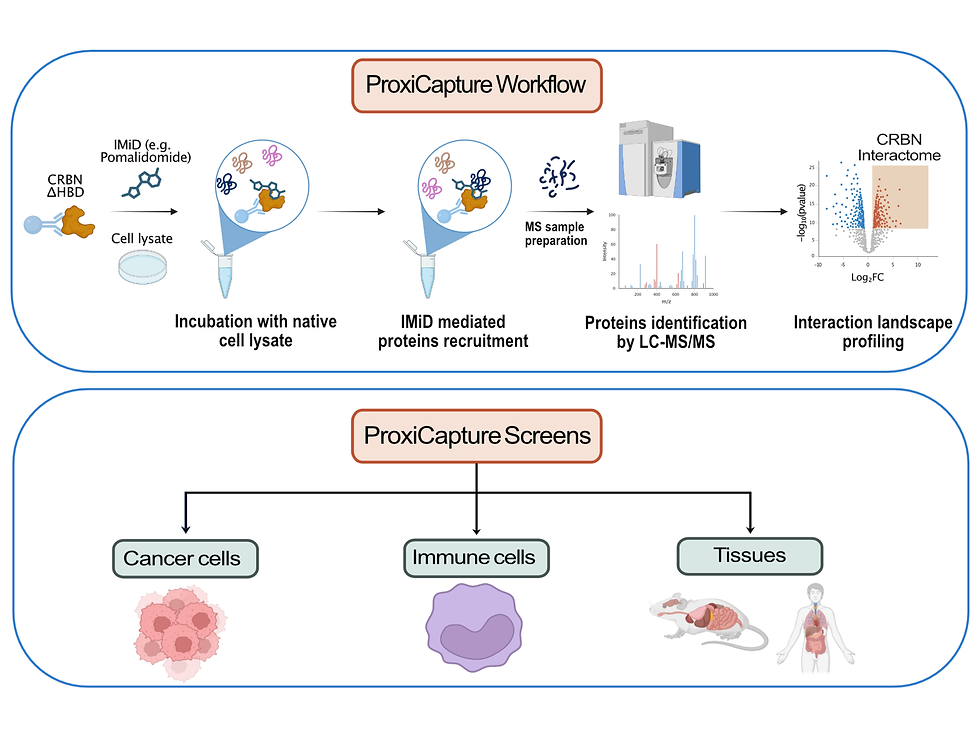
Scientists from Ivan Đikić lab at Goethe University Frankfurt and Radosław Nowak lab at the University of Bonn, within PROXIDRUGs network, invented ProxiCapture – an innovative affinity-proteomics platform that enables the systematic analysis of degrader-induced protein interactions directly in native cell and tissue samples.
Molecular glue degraders are an emerging class of small molecules that can redirect cellular protein disposal systems to eliminate disease-relevant proteins. While these compounds hold great therapeutic promise, identifying their precise targets in complex biological systems remains challenging.
ProxiCapture was developed to address this challenge. The platform combines purified E3 ligases, such as CRBN, with native cell and tissue lysates, allowing researchers to study protein interactions in a setting that closely reflects physiological conditions. This means that natural protein states and cellular contexts are preserved during analysis.
When applied across multiple cancer cell lines, different immune cell states, and paired healthy and tumor tissues, ProxiCapture revealed that the interaction patterns of molecular glues are highly dependent on the specific cell or tissue type. In total, the study identified 121 CRBN-associated proteins, including many previously unknown and context-specific targets.
Importantly, many of these interactions would not have been detected using traditional screening methods that focus only on protein degradation. By directly measuring recruitment events, ProxiCapture expands the understanding of how molecular glues function in different biological systems. PROXIDRUG researcher Rubina Kazi highlights, “The platform is highly adaptable and can be applied to diverse effector proteins and chemical compound libraries, paving the way for a comprehensive and systematic identification of interactors.”
This work represents an important step toward more rational and predictive development of molecular glue degraders and highlights the strength of interdisciplinary collaboration within the PROXIDRUGS network.